If you wanted to destroy Christianity, the most efficient method would not be persecution. Persecution has historically accelerated the church's growth. The more efficient method would be to undermine confidence in the text - to plant the suspicion that what we have in the New Testament is not what was originally written, that the Greek manuscripts are late or corrupt, that a "true Hebrew original" lies behind the Greek and has been lost or suppressed.
This suspicion is central to the Hebrew Roots Movement. And it collapses entirely when you look at the actual manuscript evidence.
What follows is not a theological argument. It is an archaeological and historical case - built from physical objects that exist, can be held, photographed, and examined. The evidence is not ambiguous, and it does not point in multiple directions. It points in one direction only.
The Scale of the Evidence
As of 2023, scholars have catalogued 5,700 Greek manuscripts of the New Testament - ranging from tiny papyrus fragments to complete bound codices. They break down into four categories:
But that is only the Greek evidence. In addition, there are over 15,000 manuscripts of the New Testament in other ancient languages - Latin, Armenian, Syriac, Coptic, Gothic, Georgian, and Ethiopic - all translated from the Greek. And the early church fathers, writing from the late 1st century onward, left over one million quotations of the New Testament in their letters, sermons, and commentaries. Scholars have calculated that even if every New Testament manuscript were destroyed, the entire text could be reconstructed almost in full from patristic citations alone.
To put this in perspective: Homer's Iliad - the most well-attested work of classical antiquity outside the New Testament - survives in approximately 647 manuscripts. Caesar's Gallic Wars survives in fewer than 10. Aristotle's works, on which much of Western philosophy rests, survive in perhaps 50 medieval copies. The New Testament is not one of the best-attested documents of the ancient world. It is in a category entirely by itself.
The Witnesses in Stone and Papyrus
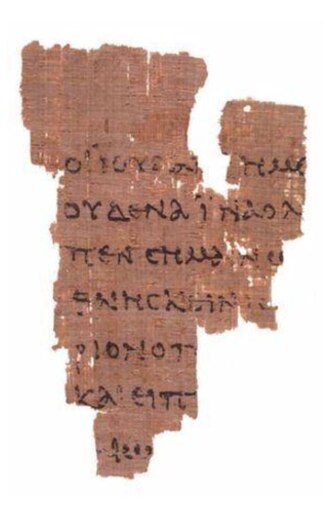
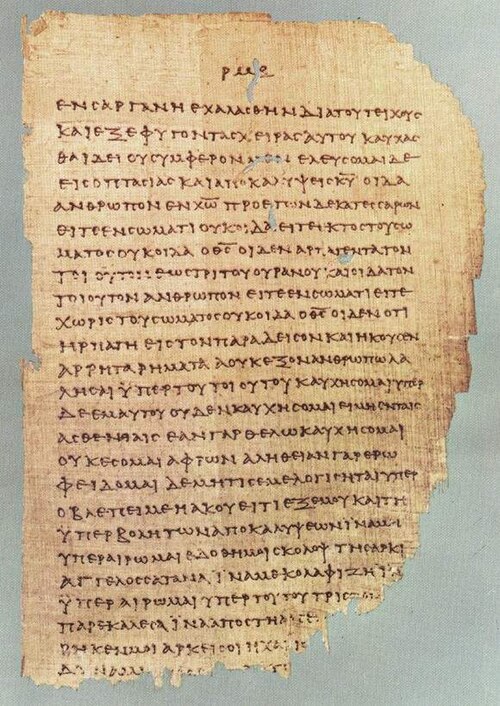
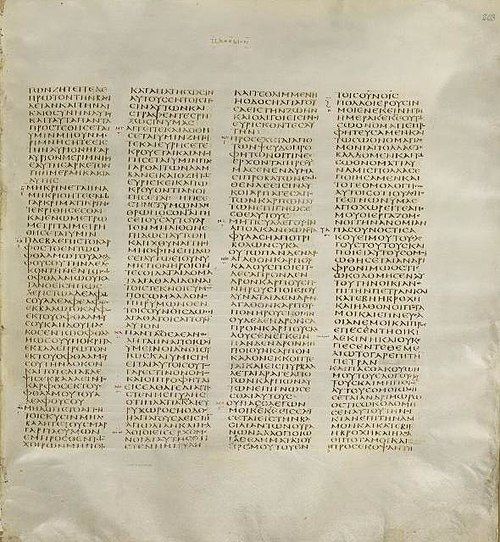
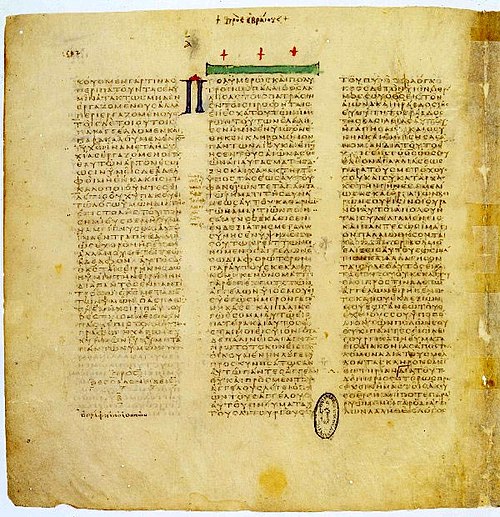
Numbers tell one story. The physical manuscripts tell another. These are not hypothetical documents or theoretical reconstructions - they are objects that survive, are housed in libraries and museums, and can be viewed by anyone. Here are the key witnesses.
Where the Manuscripts Come From
One of the most powerful features of the Greek manuscript evidence is its geographical diversity. These are not documents from a single community, preserved in a single location, representing a single tradition. They come from across the ancient world:
The papyri come overwhelmingly from Egypt - not because Egypt was the centre of early Christianity, but because Egypt's dry desert climate preserves papyrus that would have rotted within decades in Rome, Antioch, or Jerusalem. The very survival of these fragments is a geographical accident. If the climate of Palestine preserved papyrus the way Egypt does, we would almost certainly have even earlier manuscripts. Egypt gave us P52 in the sand of its antiquities market, the Chester Beatty Papyri from a jar or cave near the Fayum region, and the Bodmer Papyri from Upper Egypt.
The great uncial codices come from different regions: Sinaiticus from the Sinai Peninsula, Vaticanus from Rome (having been there at least since the 15th century), Codex Alexandrinus from Alexandria (later given to the King of England in 1627), Codex Bezae from an uncertain Eastern origin, now in Cambridge. These manuscripts were produced in different scriptoria, by different scribal hands, from different exemplars, in different parts of the Roman world - and they substantially agree.
The versional evidence widens the geography further still. The Syriac Peshitta - a translation used by the church in Syria and Mesopotamia - represents the Greek New Testament in a Semitic language, translated as early as the 2nd century. The Latin Vulgate, translated by Jerome in the late 4th century, was made from Greek manuscripts. The Coptic versions - Sahidic and Bohairic - represent the church in Egypt translating the Greek text into the native Egyptian language. The Armenian version, the "Queen of versions" for its accuracy, was made in the 5th century. All of these are translations of the same underlying Greek.
Scholars have calculated that the papyri collectively account for approximately half of the New Testament text, and that more than 43% of the New Testament is directly attested in manuscripts copied within approximately 150 years of original composition. For comparison: the gap between the composition of most classical Greek and Roman texts and their earliest surviving manuscripts is typically 800 to 1,400 years. The New Testament's manuscript tradition begins within living memory of the events it records and within decades of the original writings.
What the Textual Variants Actually Mean
Critics sometimes point to the existence of textual variants in the manuscript tradition as evidence that the New Testament cannot be trusted. There are indeed variants - scholars estimate somewhere between 200,000 and 500,000 across all manuscripts. This sounds alarming until you understand what it means.
The vast majority of variants - over 99% - are trivial: spelling differences, word order variations, the addition or omission of the definite article. The Greek word for "the Lord Jesus Christ" can be written in several different orders that all mean the same thing. A scribe who writes "Christ Jesus" instead of "Jesus Christ" creates a variant, but does not affect meaning in any way. The sheer number of manuscripts means the sheer number of trivial differences is also large.
No cardinal doctrine of Christianity - the incarnation, the atonement, the resurrection, the divinity of Christ, the nature of grace, the New Covenant - rests on a disputed text. The text-critical work of scholars like Bruce Metzger, Kurt Aland, and their successors has produced a Greek New Testament of extraordinary reliability. We know what the New Testament says. We know it because we have 5,700 Greek manuscripts that, in their overwhelming agreement, establish the text beyond reasonable doubt.
The Hebrew New Testament
This section will be brief. Not because the subject is unimportant, but because the evidence demands brevity.
There are no Hebrew New Testament manuscripts.
None. Not a fragment. Not a scrap. Not a single leaf. Zero.
There is no P52 equivalent in Hebrew. There is no Chester Beatty Hebrew Papyrus. There is no Hebrew Codex Sinaiticus. No Hebrew Matthew was found at Qumran alongside the Dead Sea Scrolls. No Hebrew Luke surfaced in the Egyptian desert. In two thousand years of manuscript discovery - from cave finds to monastery libraries to Egyptian antiquities markets to excavated rubbish heaps at Oxyrhynchus - not one Hebrew New Testament manuscript has ever appeared. The absence is not a gap in the archaeological record. It is the archaeological record speaking clearly.
Some in the Hebrew Roots Movement claim that the New Testament was originally written in Hebrew or Aramaic, and that the Greek texts are translations. This claim requires an explanation for the total absence of any such original - across 5,700 manuscripts, 15,000 versional witnesses, 1 million patristic citations, and two millennia of manuscript tradition. The HRM has no such explanation.
The Shem-Tob Matthew: What It Is and What It Is Not
The one exhibit sometimes produced in support of a "Hebrew original" claim is a document called the Shem-Tob Matthew - and it is worth examining carefully, because it illustrates exactly how the HRM case is built on historical misrepresentation.
In 1380 AD - over thirteen centuries after the New Testament was written - a Spanish Jewish physician named Shem-Tov ben Isaac ben Shaprut completed an anti-Christian polemical treatise called Even Bohan ("The Touchstone"), intended to defend Judaism against Christian missionary activity. Embedded in the twelfth volume of this treatise is a complete Gospel of Matthew in Hebrew. The surviving copies of this manuscript date from the 15th to 17th centuries.
This is the entire Hebrew manuscript tradition for Matthew. One medieval document, produced in 14th-century Spain, embedded in an anti-Christian polemic, surviving in copies no earlier than the 15th century.
The scholarly debate is not whether this is an ancient Hebrew original - it clearly is not. The debate is whether Shem-Tob himself translated Matthew from the Greek and Latin texts he had access to (which most scholars conclude), or whether he worked from an earlier medieval Hebrew version that itself derived from the Greek. Either way, no one in the mainstream academic community treats this text as evidence of a first-century Hebrew Matthew.
The internal evidence against its antiquity is compelling. William Petersen's detailed 1989 analysis found extensive alignment between Shem-Tob's Matthew and medieval Latin traditions - specifically the Liège Diatessaron (a harmony of the Gospels) and its Middle Dutch descendants. Unique readings in Shem-Tob appear in these medieval Western manuscripts and nowhere else. The linguistic strata of the text reflect 13th–14th century southern France or Catalonia, including liturgical notations from the Narbonne tradition. The Hebrew itself shows transitional forms consistent with medieval Jewish Iberian writing, not first-century Palestinian Hebrew.
More telling still: Shem-Tob's Matthew is theologically anti-Christian. As George Howard - the scholar most sympathetic to the text's antiquity - himself admitted, the document never identifies Jesus as the Messiah. Matthew 28:19-20, the Great Commission, appears in a truncated form that removes the Trinitarian baptismal formula. The text serves its author's purpose, which was to argue against Christianity, not to preserve apostolic tradition.
The view that Shem-Tob's Matthew represents a 14th-century translation or recension derived from Greek and/or Latin sources - and therefore tells us nothing about a first-century Hebrew original - is the mainstream scholarly position. George Howard's minority argument that the text predates the 14th century was "rejected by W.L. Petersen and Petri Luomanen," and most scholars considering all the evidence conclude that the unique readings in Shem-Tob reflect dependence on medieval Western Christian traditions, not an ancient Hebrew source. The oldest surviving copies are 15th-century manuscripts. The original author was writing in 14th-century Aragon. Every line of internal and external evidence points to a medieval origin.
To be clear: even if one accepted Howard's most generous reading - that Shem-Tob worked from an older Hebrew text - that older text would still post-date the Greek manuscripts of Matthew by over a millennium. P52 was copied within living memory of the apostles. Shem-Tob's Matthew was written 1,300 years later. The comparison is not competitive.
The Most Certain Text in the Ancient World
Textual critics - scholars whose discipline is evaluating the reliability of ancient texts - speak of the New Testament's manuscript tradition in terms they apply to no other ancient document. F.F. Bruce, one of the 20th century's most respected New Testament scholars, observed that the evidence for the New Testament's text is far greater than for any other work of classical antiquity, and that the authenticity and general integrity of the books of the New Testament may be regarded as finally established. Bruce Metzger, who spent his career studying New Testament manuscripts, concluded that the text of the New Testament is preserved to a degree of accuracy "far beyond that of any other work of ancient literature."
This is not a claim made by apologists trying to defend a religious position. It is the conclusion reached by scholars who have spent careers handling, cataloguing, photographing, and analysing ancient manuscripts - including scholars who are not Christians and have no stake in the result. The evidence compels the conclusion.
We know what the New Testament says. We know it in Greek, because Greek is what it was written in. We know it because 5,700 manuscripts from Egypt, Rome, the Sinai, Alexandria, Antioch, and the British antiquities market all say the same things. We know it because 15,000 translations in Latin, Syriac, Coptic, Armenian, Georgian, Ethiopian, and Gothic all translate the same Greek text. We know it because the church fathers quoted it over a million times from the late first century onward - in Greek.
What This Means for the Hebrew Roots Movement
The Hebrew Roots Movement's claim that the New Testament was originally in Hebrew, or that recovering a "Hebrew original" unlocks meanings distorted by Greek translation, is not a position that can survive contact with the manuscript evidence. It is not a matter of interpretation or theological perspective. It is a matter of what physical objects exist and what they say.
No Hebrew New Testament manuscripts exist. The Greek manuscripts that do exist are among the most numerous, the most ancient, the most geographically diverse, and the most internally consistent documentary witnesses to any text in the ancient world. The Greek New Testament is not a translation. It is not a corruption. It is the New Testament - original, documented, and confirmed by an archaeological record of extraordinary weight.
The New Covenant was written in Greek. It was written in the language that three centuries of Hellenisation had prepared as the universal tongue of the ancient world. It was written in the language the Septuagint had spent two centuries loading with the theological vocabulary of the Hebrew scriptures. It was written in the language that the Spirit of Pentecost was already exploding across, as the gospel raced down Roman roads to every nation under heaven.
There is no Hebrew original to recover. There is only the text we have - ancient, attested, and trustworthy - in the language God chose to deliver the New Covenant to the world.
Heaven and earth will pass away, but my words will not pass away. - Matthew 24:35
Alexander the Great died at thirty-two, but the world he created outlasted him by centuries. Three hundred years of Greek language,...
Jewish scholars produced it. Diaspora synagogues read it. The apostles quoted it as scripture. The Septuagint - the Greek translation of...
The Hebrew Roots Movement claims the Old Testament is the interpretive key to the New. This article shows through six specific examples...